
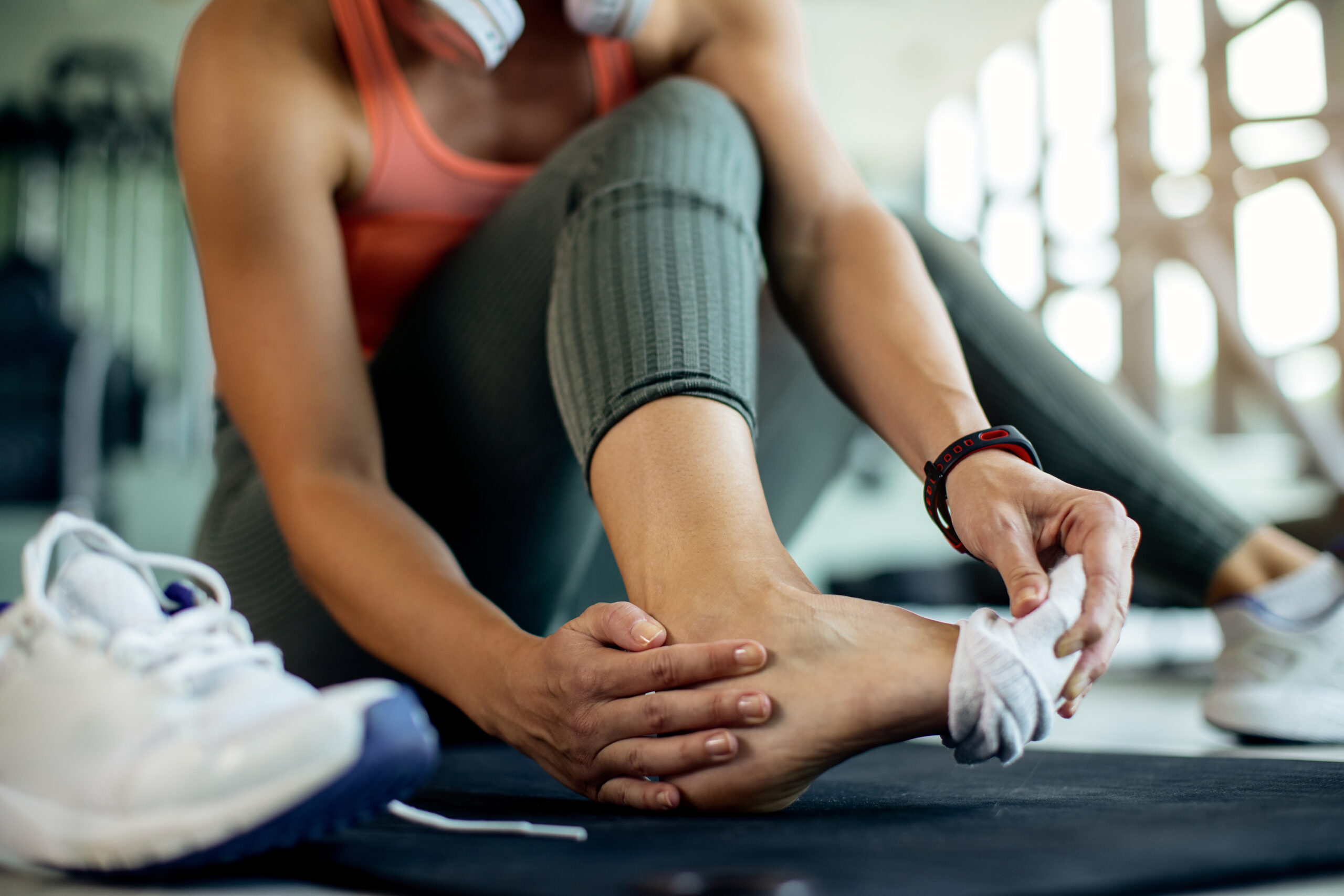
When we push too hard, too soon, our tissues reach their "threshold”.
- Strains: Injuries to muscle or tendon (the tissue connecting muscle to bone). Think of the "pulled hammy" we’ve discussed in a previous blog before.
- Sprains: Injuries to ligaments (the tough bands connecting bone to bone), common in ankles when we start running on uneven trails.
- Tendinopathy: This is the "overuse" injury. It’s not a sudden tear, but a failure of the tendon to keep up with the load, leading to persistent pain in areas like the Achilles, knee, hip, shoulder or elbow.
The Science: It’s All About "Load"
One of the most important concepts in modern sports medicine is the Acute:Chronic Workload Ratio. Research by sports scientist Tim Gabbett (2016) suggests that most injuries don't happen because of exercise itself, but because of a sudden spike in how much we do.
From an Osteopathic perspective, your body is an amazing adapter, but it requires balance. If your "Chronic Load" (what you’ve done over the last few months) is low, and your "Acute Load" (this week's training) is high, your system's equilibrium is thrown off. Your tissues need a graded approach to adapt and get stronger!
Myth-Busting: "No Pain, No Gain"
A study by Jill Cook and Craig Purdam (2009) describes the "Tendon Continuum." If you ignore the initial "grumble" of a tendon and keep pushing, it moves from a reactive state into a degenerative one.
As Osteopaths, we look at the interrelation of this pain. A grumbling Achilles might not just a foot problem but it might be a symptom of a stiff ankle or a lack of power in the hip. We don't just treat the "grumble", we look at the mechanics of the whole machine to prevent that tendon from reaching its breaking point.
4 Tips for a Sustainable 2026
- The 10% Rule: Aim to increase your total weekly volume by no more than 10%. This respects the biological pace of tissue remodeling.
- Strength is Shielding: Incorporating strength training twice a week makes your ‘framework’ more robust. Research shows this can reduce overuse injuries by nearly 50% (Lauersen et al., 2014).
- Prioritise Recovery: As our "Sleep Hygiene" blog mentioned, sleep is your body's primary repair shop.
- Check Your Mechanics: If you have a "niggle" that won't go away, it’s your body's way of saying something is out of sync.
How Osteopathy Can Help You Win
Osteopathy is uniquely suited for the "New Year" athlete because we focus on optimising your structure to improve your function. We don't just put a band-aid on the strain, we assess how your spine, pelvis, and limbs are working together. Whether it's using hands-on techniques to improve joint mobility or working with our Exercise Physiologists to design a loading program that won't break you, our goal is to keep you on the track, not the sidelines.
Let’s make sure your 2026 fitness journey is a marathon, not a sprint. If things are feeling "tight" or "out of alignment," come in and see us!
REFERENCES:
Brinjikji, W., et al. (2015). Systematic Literature Review of Imaging Features of Spinal Degeneration in Asymptomatic Populations. American Journal of Neuroradiology, 36(4), 811-816.
Gabbett, T. J. (2016). The training—injury prevention paradox: should athletes be training smarter and harder? British Journal of Sports Medicine, 50(5), 273-280.
Cook, J. L., & Purdam, C. R. (2009). Is tendon pathology a continuum? A pathology model to explain the clinical presentation of load-induced tendinopathy. British Journal of Sports Medicine, 43(6), 409-416.
Lauersen, J. B., Bertelsen, D. M., & Andersen, L. B. (2014). The effectiveness of exercise interventions to prevent sports injuries: a systematic review and meta-analysis of randomised controlled trials. British Journal of Sports Medicine, 48(11), 871-877.